Operational assessment
A structured review of your operations, processes, governance and data maturity to identify hidden waste, root causes and the growth levers that matter most.
Best for: Organizations unsure where improvement should start
How we work
We start by understanding how your business really works, remove what adds no value, then design, implement and measure what does. Clear steps, shared ownership, measurable results.
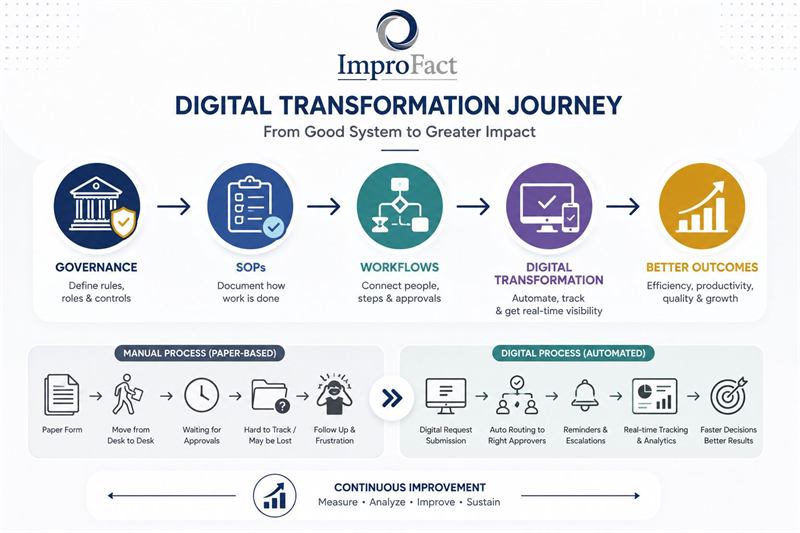
The engagement journey
Step 1 · Understand
We start by understanding your strategy, customers, culture, KPIs and challenges. We meet stakeholders, visit operations and listen carefully before drawing conclusions.
Step 2 · Diagnose
We map how work really happens and look beyond the visible symptoms. We ask what organizational conditions are producing the results you see.
Step 3 · Design
Together with a cross-functional team, we redesign workflows, remove unnecessary steps and define clear roles and authority. Then we capture the new way of working in practical SOPs and governance.
Step 4 · Implement
We support implementation with a Project Champion who removes roadblocks and keeps momentum. Training and workshops build the skills your teams need to own the change.
Step 5 · Measure
What gets measured gets improved, so we put action-oriented KPIs and dashboards in place. Regular reviews turn information into decisions and further improvement.
Step 6 · Sustain
Resolution does not end with a meeting; we follow up to ensure results are sustained. We help embed governance and a culture of continuous improvement, so you can then scale on a stronger foundation.
Our principles
Before adding people, systems, meetings or approvals, ask what should be removed. Sometimes it is about stopping what should never have been done in the first place.
Read: Addition by Subtraction: Sometimes Less Creates MoreInstead of concluding "We have difficult employees", ask what organizational conditions are producing the behavior. When the signals change, behavior can change.
Read: Organizational Behavior: Your People Are Not the Problem. The System Might Be.Don't digitize inefficiency, don't hire around waste, don't scale what is broken. First build the right processes, then digitize them.
Read: The Coach Said: “Don’t Build Muscle Yet.”A good dashboard does not show everything; it shows what matters. Data tells you what happened, KPIs tell you what action to take.
Read: KPI Dashboard Blueprint: What Gets Measured Gets ImprovedGovernance should create clarity, not stop momentum. Give teams the authority to move fast on normal business and involve senior leadership where the risk requires it.
Read: Contract Review Starts Before the ContractWe are here to create value; money comes as a result. When value is the priority, trust is built, teams develop and results last.
Read: Make Money or Create Value? Two Different MindsetsWays to work with us
A structured review of your operations, processes, governance and data maturity to identify hidden waste, root causes and the growth levers that matter most.
Best for: Organizations unsure where improvement should start
A focused project to redesign a specific process, workflow or governance framework with a Project Champion and cross-functional team, from current state to implemented solution.
Best for: A known process problem or digitization initiative
A tailored plan that turns a new or promoted leader's first three months into planned execution: learn, analyze and plan, then execute and deliver measurable results.
Best for: New managers and leaders stepping into roles
Practical training programmes and facilitated workshops, from leadership and conflict resolution to business planning and value-based selling, built on real examples you can apply.
Best for: Building team and leadership capability
Questions
We start by understanding your business and diagnosing where hidden waste, unclear processes or repeated issues are limiting performance. Rather than guessing, we map processes, look for root causes and use KPIs to make the real problems visible, then prioritize the improvements that create the most value.
No. Improvement is not about reducing resources blindly; it is about eliminating waste and freeing resources for higher-value work. Often the same team can handle more with less effort once duplicated work, unnecessary approvals and scattered information are removed.
Adding a new system won't solve a broken process. We recommend establishing governance, SOPs and workflows first, then digitizing them, because technology automates processes but doesn't redesign them.
Business processes affect everyone, so we work with a Project Champion who removes roadblocks and makes timely decisions, supported by a cross-functional team from the functions involved. An internal leader understands the culture while an external partner brings fresh perspective and proven methods; the best approach often combines both.
Both. Alongside designing processes, SOPs and governance, we run practical training programmes and leadership workshops, covering topics such as conflict resolution, emotional intelligence, governance, business planning and value-based selling, so your teams can sustain the improvements themselves.
Yes. ImproFact shares its thinking and programmes in both English and Arabic, and our approach to culture, leadership and governance is designed to be practical in either language.
Start with a focused operational audit. No obligation, and a clear picture of where to begin.