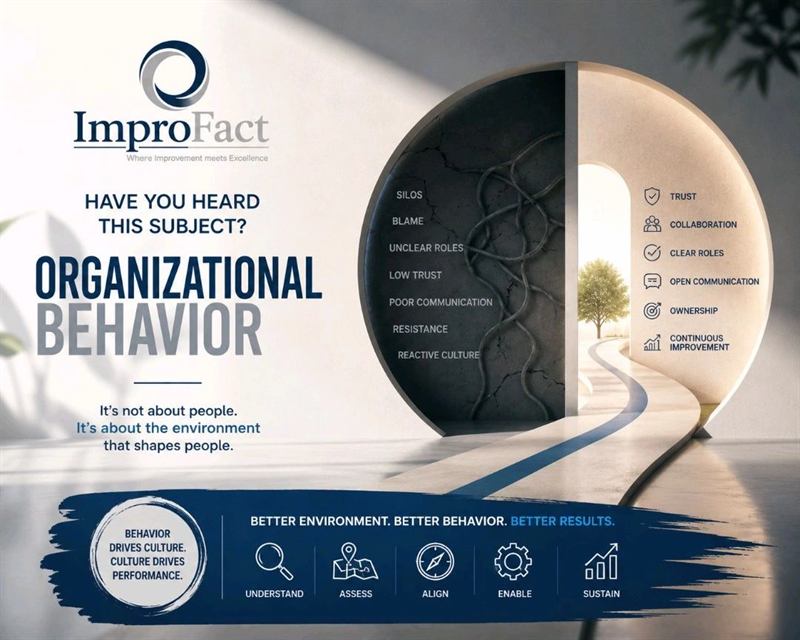
What is Organizational Behavior?
Organizational behavior is the study of how people behave, interact, communicate, make decisions, and respond to change within an organization—and how the organization itself shapes that behavior.
It is not simply about personalities.
It is about leadership, culture, systems, processes, incentives, communication, and relationships that influence how people behave collectively.
What shapes organizational behavior?
- Leadership: What leaders tolerate, reward, and demonstrate becomes a signal to others.
- Culture: What people actually practice, not what is written on the wall.
- Processes: Unclear roles and inefficient workflows create frustration and conflict.
- Communication: When information is unclear, people create their own assumptions.
- Rewards: People tend to repeat what gets recognized and rewarded.
- Trust: When people fear blame, they protect themselves instead of solving problems.
The danger? Negative behavior becomes normal.
Imagine Sales blaming Operations for delays, while Operations blames Sales for unrealistic commitments. Management responds with more reports and controls, while employees stop raising problems.
Eventually, everyone accepts it as “the way things work.”
It becomes the culture.
The easy conclusion is:
“We have difficult employees.”
But the better question is:
“What organizational conditions are producing this behavior?”
So, how do we change it?
Don't simply tell people to “behave better.”
Understand the causes first.
Then align:
- Leadership
- Culture
- Processes
- Accountability
- Communication
- Recognition
If you want ownership, give people authority and accountability.
If you want collaboration, recognize and reward it.
If you want transparency, make information accessible.
If you want improvement, create a safe environment for identifying problems.
A practical example
A manager says:
“My team doesn't take ownership.”
Management investigates and discovers that employees need approval for almost every decision, mistakes are publicly blamed, performance measures focus on individual activity, and initiative is rarely recognized.
The message employees receive is:
“Don't take risks. Just follow instructions.”
Changing the behavior requires changing the environment.
When the signals change, behavior can change.
How can ImproFact help?
At ImproFact, we treat organizational behavior as part of the wider business system, not simply as a human-resources issue.
We help organizations identify behavioral challenges and their root causes, then strengthen leadership alignment, culture, governance, role clarity, performance management, communication, recognition, and continuous improvement.
Because a positive workplace is not created by designing an environment where the right behaviors are understood, enabled, reinforced, and sustained.