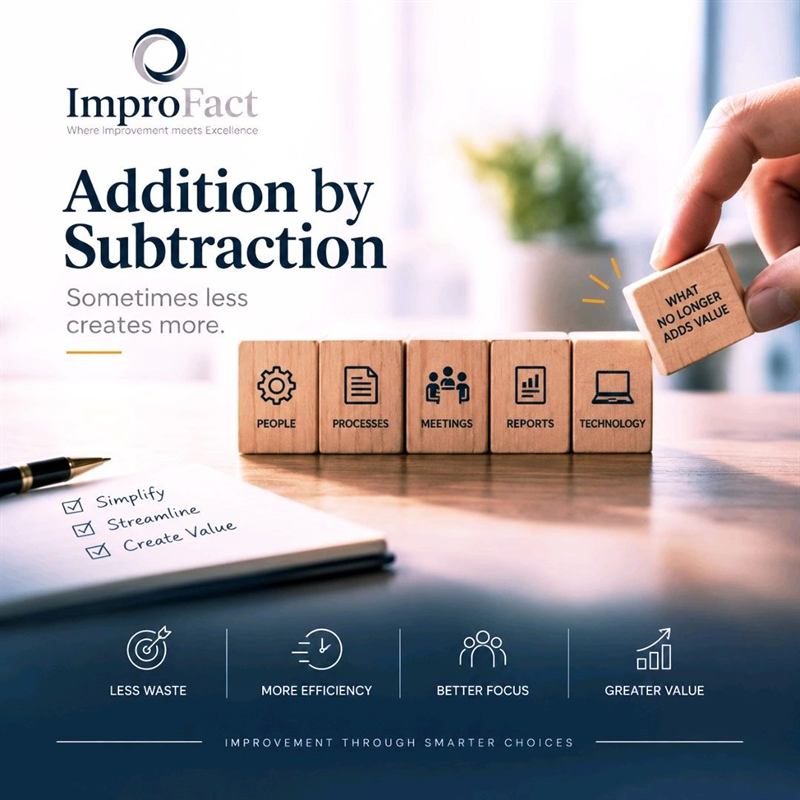
When organizations want to improve, the first question is often:
“What should we add?”
- More people.
- More systems.
- More meetings.
- More reports.
- More controls.
- More technology.
But sometimes the better question is:
“What should we remove?”
This is the concept of Addition by Subtraction—creating more value by eliminating what no longer adds value.
Practical Examples
More employees?
Maybe the real problem is duplicated work, unclear responsibilities, or inefficient processes.
More meetings?
Perhaps removing unnecessary meetings and improving communication channels would create more productivity.
More approvals?
Too many approval layers can slow decisions without necessarily reducing risk. Clear authority levels may work better.
More reports?
If nobody uses them to make decisions, they may be administrative waste rather than useful information.
More software?
Adding a new system won't solve a broken process. Sometimes simplifying the process first is the better improvement.
More procedures?
Not every problem needs another SOP. Sometimes an existing process simply needs to be simplified and clarified.
A Simple Improvement Question
Before adding anything, ask:
- Does this activity create value?
- Does it reduce risk?
- Does it support a decision?
- Does the customer benefit from it?
If the answer is no, it may be time to remove, simplify, consolidate or redesign.
This is not about reducing resources blindly.
It is about eliminating waste and freeing resources for higher-value work.
How Can ImproFact Help?
At ImproFact, we help organizations identify opportunities for improvement by subtraction through:
- Process mapping and waste identification
- Role and responsibility analysis
- Workflow simplification
- Meeting and reporting optimization
- Approval and authority review
- SOP and policy simplification
- Resource utilization analysis
- Process redesign and automation readiness
Because operational excellence is not always about doing more.
Sometimes, it is about stopping what should never have been done in the first place.
- Remove the unnecessary.
- Simplify the complicated.
- Free the resources.
- Create more value.
ImproFact — Where Improvement Meets Excellence.