In our previous posts, we discussed how organizations should first establish Governance, SOPs, and Workflows before starting the digital transformation journey.
The next question is: Who should own the transformation?
Many organizations assign it to IT because technology is involved, but that's a misconception.
Digital transformation is a business initiative enabled by technology.
Technology automates, but doesn't redesign processes.
Who Should Lead?
There’s no single answer; it depends on organization size, strategy, industry, and capabilities.
The leader should understand operations, governance, process improvement, change management, KPIs, stakeholder management, and project management.
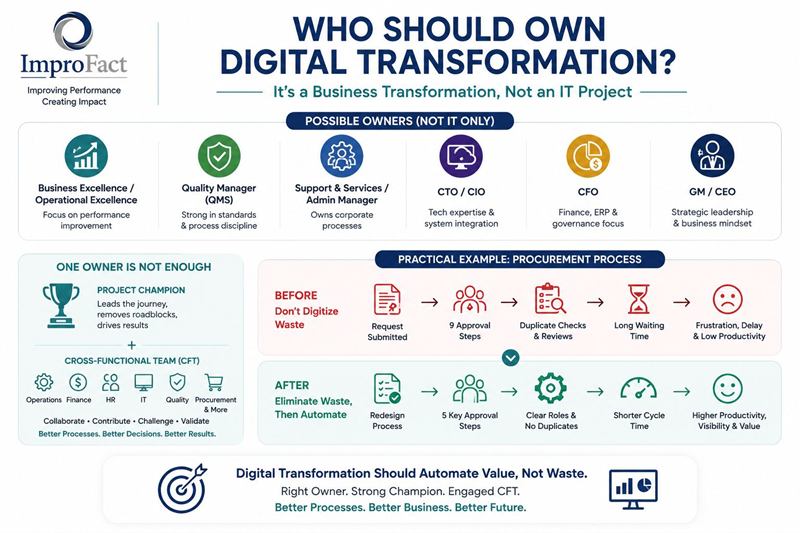
Possible owners include:
- Business Excellence/Operational Excellence Manager – Fits well as they focus on improving performance, but need authority for organization-wide change.
- Quality Manager (QMS) – Good for standardization and compliance, but risk focusing too much on documentation.
- Support & Services or Administration Manager – Suitable if overseeing corporate processes, but must balance transformation with daily tasks.
- CTO/CIO – Great for technology deployment, but beware of treating it as just software implementation.
- CFO – Appropriate for ERP and financial governance, but focus may shift to compliance and costs.
- CEO/General Manager – Capable if they have the right business mindset and experience, though they may have limited time.
The title is less important than capability.
One Owner Is Not Enough
Every transformation should have a Project Champion responsible for removing roadblocks, making timely decisions, and maintaining momentum.
The Champion should lead a Cross-Functional Team (CFT) representing Operations, Finance, HR, Procurement, Sales, Projects, IT, and Quality. Business processes affect everyone, so every function should contribute to designing the future way of working.
The best processes are built by collaboration, not by one department.
Practical Example:
A company digitizes its Procurement Process, starting simple: automating approval workflow.
The Champion gathers a team, finds the current process has unnecessary steps.
They question each step, redesign the workflow, and reduce approvals from nine to five.
This results in a process that’s faster, clearer, and more efficient, better than just digitizing waste.
Internal team or external consultant?
An internal leader understands the culture; an external brings fresh perspective and proven methods.
The best approach often combines both.
How We Help at ImproFact
We assess operations, establish governance, redesign processes, facilitate workshops, manage change, and support digital transformation with methodologies like Lean, DMAIC, BPM, and Operational Excellence.
Remember, digital transformation is about working differently and technology accelerates that change.