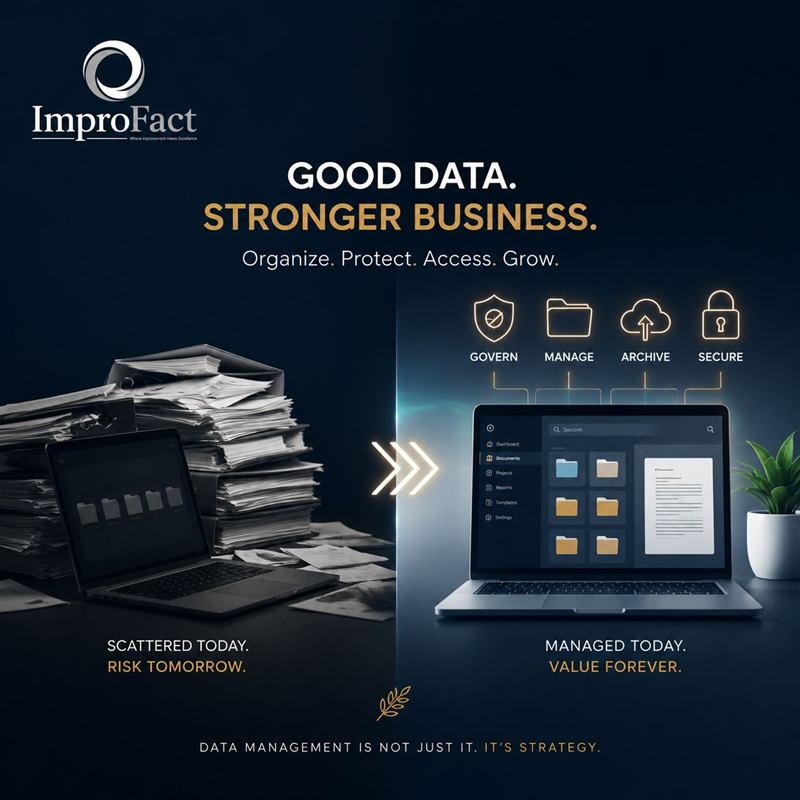
Many organizations invest heavily in projects, systems, and people, but forget one critical asset that remains after everything changes:
Data.
Data management is not just about storing files. It is about creating a structured approach to collect, organize, protect, access, maintain, and use information effectively throughout the business lifecycle.
A company without proper data management may have thousands of documents, but still cannot find the information it needs when it matters.
Example: Recently, we faced a situation with a client where a previous customer contacted them requesting technical support 8 years after project completion
The challenge?
- The entire previous project team had left.
- There was no proper handover.
- No centralized documentation.
- No project archive.
- No backup knowledge.
The project information was mainly stored locally on engineers' laptops, and after they left, the organization lost access to critical knowledge.
The result?
The company struggled to support its own customer, not because it lacked technical capability, but because it lost its own data.
This is a hidden risk many organizations underestimate.
So, what does effective Data Management require?
- Data Governance Establishing clear ownership, responsibilities, access rights, security rules, and standards for managing information. — Who owns the data? Who can access it? How long should it be retained? How should it be classified and protected?
- Procedures and Standards Creating clear processes for documentation, naming conventions, approval workflows, version control, and archiving. — A project should not end when the team leaves. The knowledge should remain within the organization.
- Centralized Systems Moving from personal storage and scattered files into structured platforms such as document management systems, enterprise resource planning systems, customer relationship management systems, and other digital platforms.
Digital transformation is not only about digitizing documents.
It is about creating visibility, control, and accessibility.
Do not digitize chaos.
First build the right processes, then digitize them.
How ImproFact Can Help
At ImproFact, we help organizations transform information from scattered files into a managed business asset.
We support organizations in assessing their current data maturity, establishing governance frameworks, designing procedures, defining documentation standards, selecting suitable systems, and building practical roadmaps toward digital transformation.
Because a successful organization is not only built on what people know today.
It is built on what the organization can preserve, transfer, and improve tomorrow.
Your people may leave. Your systems may change. But your knowledge should stay.
ImproFact — Where Improvement Meets Excellence.