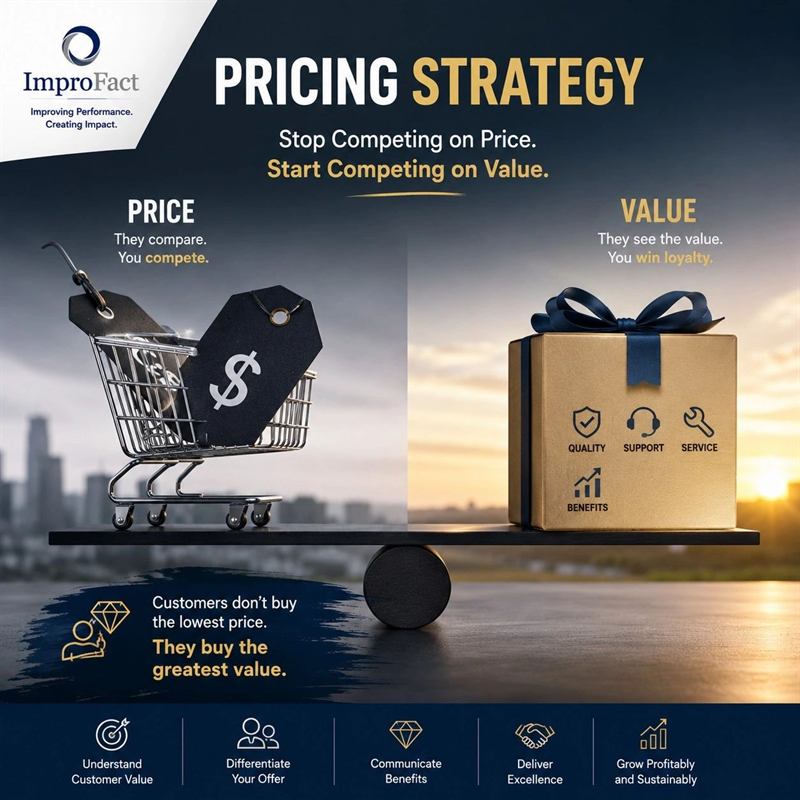
One of the biggest mistakes companies make is believing that lowering prices is the fastest way to increase sales.
It may increase sales temporarily, but it often reduces profitability, weakens the brand, and starts a price war that nobody wins.
Successful companies don't ask:
"How can we be cheaper?"
They ask:
"Why is our solution worth more?"
What Is a Pricing Strategy?
A pricing strategy is the method an organization uses to determine the right price for its products or services while balancing customer value, profitability, competition, and market positioning.
Pricing is not a Finance decision alone.
It is a strategic business decision involving Marketing, Sales, Operations, Procurement, and Finance.
Common Pricing Strategies
- Cost-Plus Pricing – Cost + desired profit margin.
- Value-Based Pricing – Price reflects the value perceived by the customer.
- Competitive Pricing – Position against competitors.
- Premium Pricing – Higher price to reinforce quality and exclusivity.
- Penetration Pricing – Lower introductory price to gain market share.
- Bundle Pricing – Combine products or services to increase perceived value.
The best strategy depends on your market, customers, and competitive advantage.
A Practical Example
Two companies sell the same Split AC Unit for a villa.
Company A says: "Our AC costs SAR 2,300."
The customer compares prices.
Company B says: "Our solution includes free site inspection, professional installation, five-year compressor warranty, preventive maintenance reminder, energy-efficient operation that reduces electricity bills, and priority after-sales support."
The customer is no longer comparing only the unit. They're comparing the value.
Company B doesn't sell an air conditioner. It sells comfort, reliability, lower operating costs, and peace of mind.
That's the difference between selling a product and selling value.
Before Changing Prices, Ask Yourself
- Are customers buying price or value?
- What makes us different?
- Can we bundle services?
- Can we improve the customer experience?
- Are we communicating benefits instead of features?
- Do our salespeople know how to justify the price?
Many companies don't have a pricing problem.
They have a value communication problem.
Common Mistakes
- Competing only on discounts.
- Ignoring customer perception of value.
- Using one pricing strategy for all customers.
- Allowing salespeople to discount too quickly.
- Failing to calculate total customer lifetime value.
How We Help at ImproFact
At ImproFact, we help organizations develop pricing strategies aligned with market position, customer expectations, and profitability.
We train sales teams to convert features into benefits, strengthen value propositions, analyze competitors, improve sales processes, and create pricing models that protect margins and boost customer satisfaction.